


An outtake from Sunday School: Drop In, Vibe On.
In this session, Eleanor Berger hosted Zain Hoda to explore X1PM, a lightweight, shared workspace designed to bridge the gap between human collaboration and AI agents. While current agentic workflows often rely on complex tool calling for software like Google Workspace or GitHub, X1PM proposes a radically simplified approach: interacting purely through standard Markdown and CSV files.
This presentation showcased how shifting away from heavy platform-specific formats to an agent-native file system allows both humans and multiple AI agents to read, write, and collaborate on the same set of documents seamlessly.
The Motivation Behind X1PM
The core philosophy of X1PM stems from the observation that while AI agents are generally excellent at navigating traditional codebases and file systems, they often struggle when presented with overly complex tools.
“A lot of people have had the observation that agents are really good at interacting with file systems. And so I think a lot of what people have discovered is that you know if you connect your agent to MCPs that are extremely complex they kind of struggle with that.”
Zain noted that connecting agents to dense services, such as a Google Workspace MCP or a GitHub MCP with dozens of available tools, can lead to context rot and confusion for the models. The solution was to return to basics, leaning into file formats that agents process naturally. In Zain’s personal workflow, he effectively replaced Google Docs with standard Markdown files and Google Sheets with simple CSV files.
Although this approach works locally, it becomes challenging when trying to access those documents from the web or from a mobile client. X1PM solves this by providing an interface that looks and feels like a structured workspace but operates on top of these raw, agent-friendly files. It acts as an orchestrator, or a shared space, exposing standard file-system operations — such as reading, writing, searching, and editing — via an MCP server.
Building a Unified Agent Experience
Eleanor noted that this approach beautifully addresses a pain point many AI-native developers experience when using local filesystem-based tools and workflows.
“I love this approach of using markdown files and CSV files because you don’t need all this heavy software... but what I realize that I’m missing is a space that makes it easier for me to collaborate with the agent.”
With a local workflow, connecting an agent on a phone or jumping to a web UI is difficult. X1PM bridges the gap between the structured, readable UI of a SaaS application and the simple file-system access required by coding agents.
The Live Demo
During the session, Zain provided a live demonstration of X1PM in action, emphasizing how easily an agent can interact with the structured data. He used a lightweight CRM system built entirely from a CSV file.
He initiated an interaction using the Claude app, instructing the agent to update a specific contact’s status in the CRM.
“I’m going to tell Claude in the demo CRM, change Emma Wilson’s status to closed won. And this is like full live demo, so I have no idea if this is going to work.”
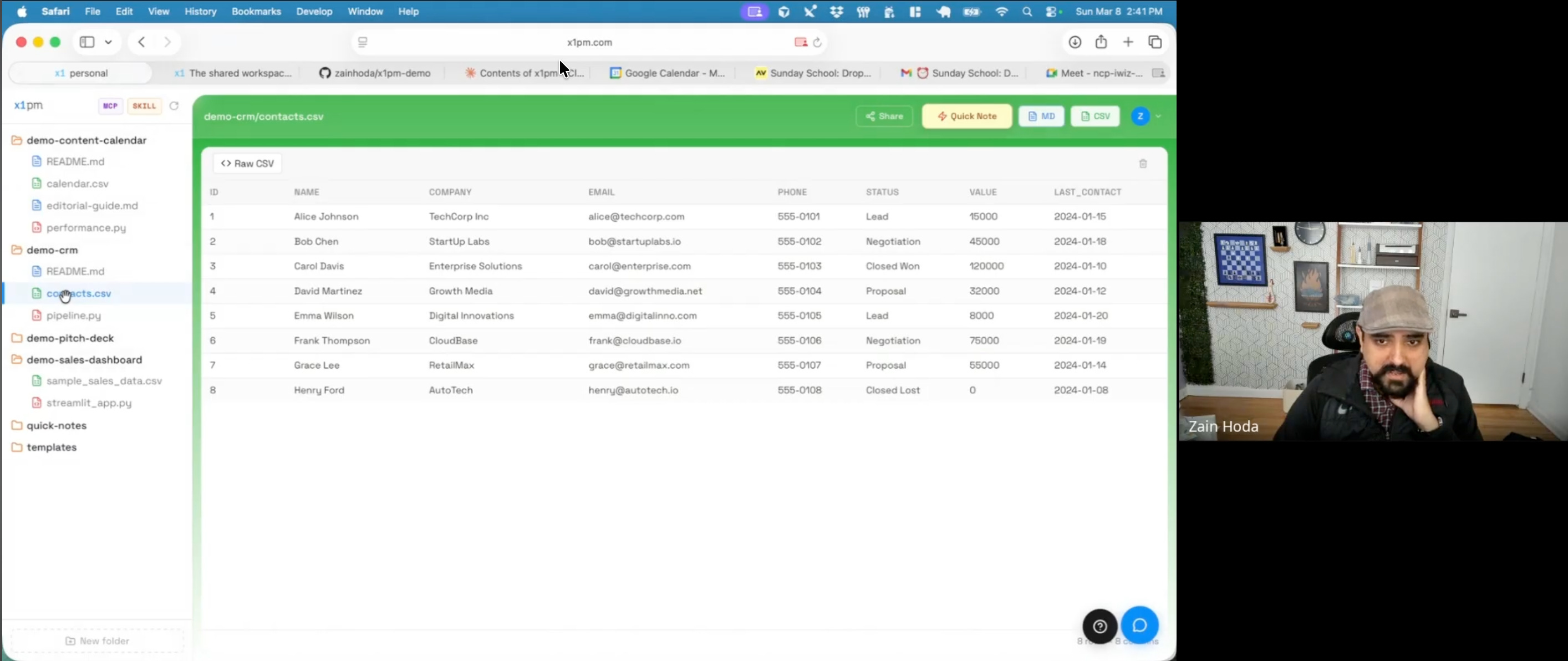
The agent quickly listed the files, searched the structure, and correctly updated the CSV file. A quick refresh of the X1PM web interface confirmed the change, demonstrating the zero-friction collaboration between human intention, agent execution, and the resulting shared truth in the file.
Cross-Agent Continuity
One of the most striking aspects of the workspace is the ability to run multiple tools seamlessly over the same context. Zain demonstrated switching between Claude, a custom coding agent in a GitHub Copilot setup, and the Cursor IDE.
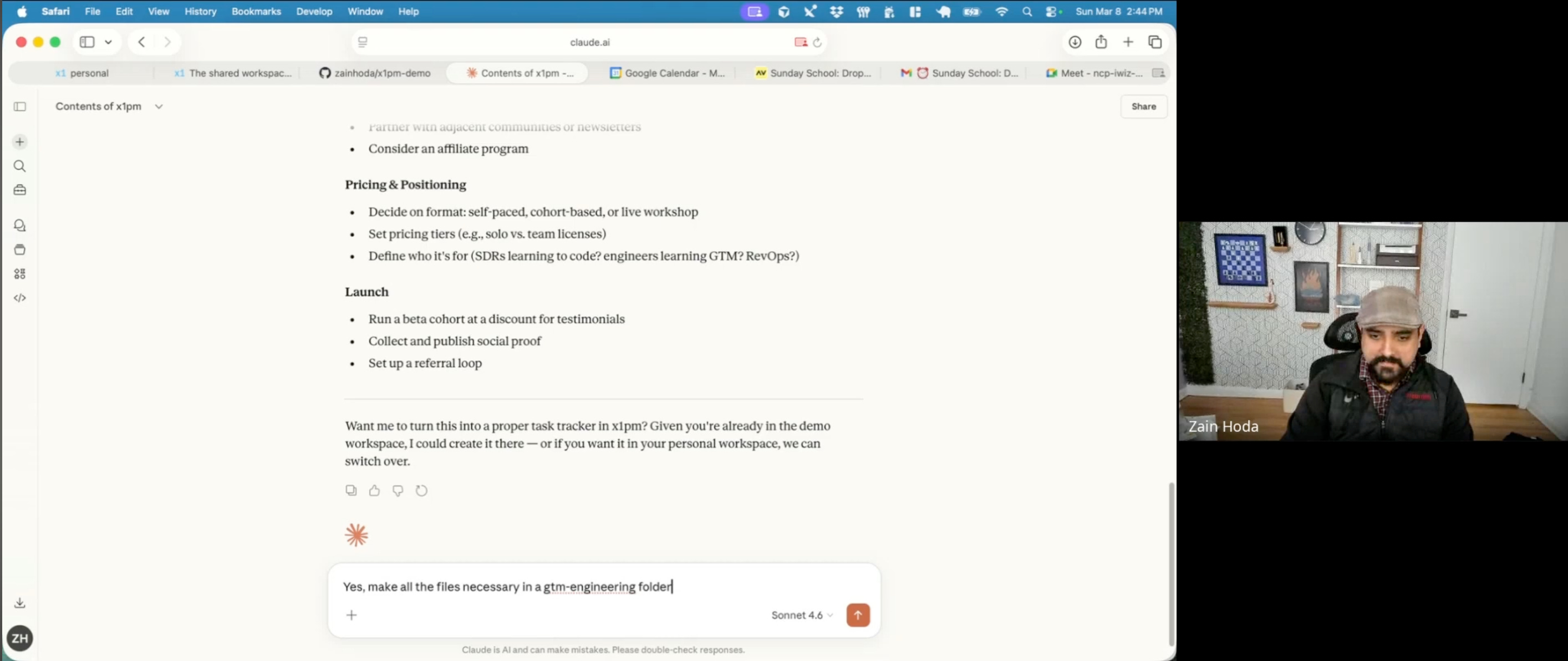
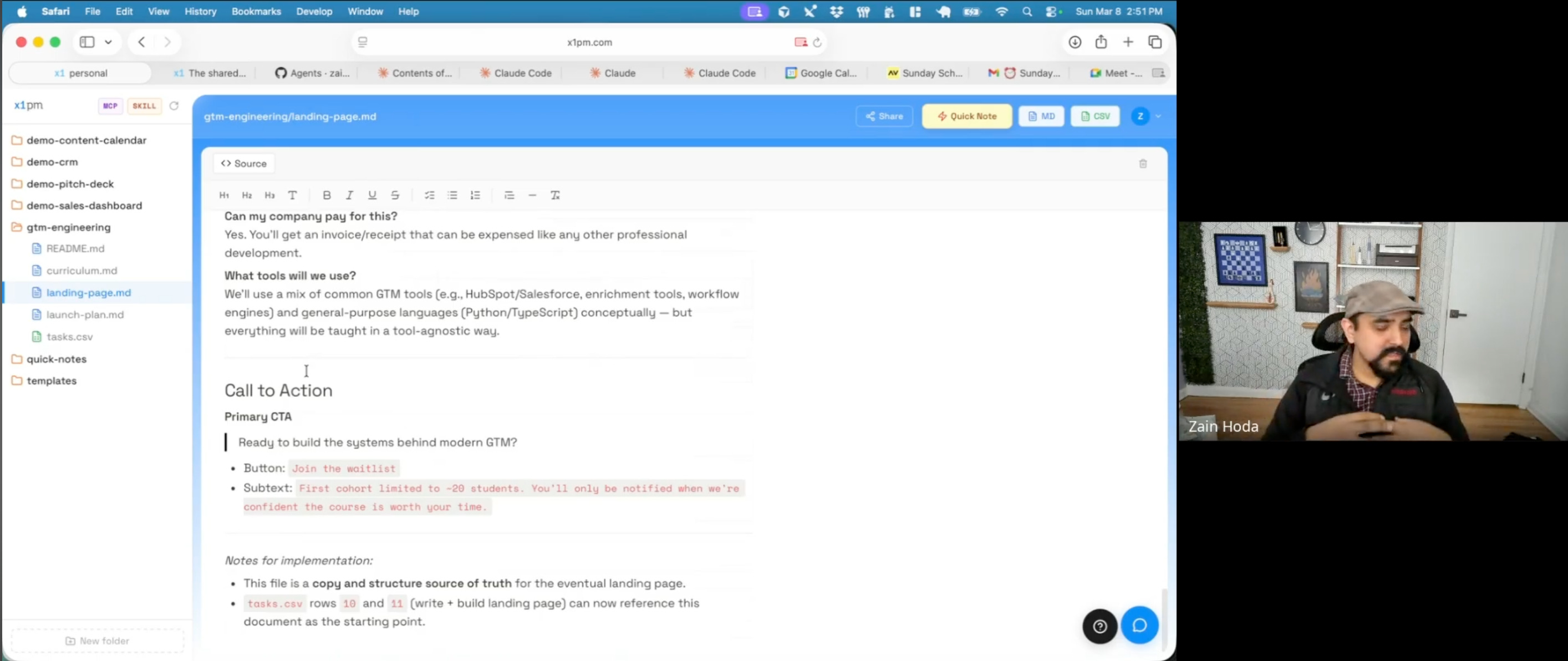
He tasked Claude with generating the requirements and file structure for a “GTM Engineering” course. Claude set up a directory populated with a README.md, tasks, curriculum, and a launch plan.
Because X1PM is exposed as a file system, Zain could then switch over to Cursor and ask it to begin building out a landing page for the project based on the context Claude had just generated. Cursor had instant access to the newly created folders and files.
Eleanor pointed out the significant benefit of having this level of consistency:
“It’s also really cool that you have this consistency because the interface is so simple and this file system tools actually can switch agents, switch models, and they’ll all kind of well assuming the models are good enough, they all kind of still figure out what to do.”
By rooting the context in standardized text files, the environment becomes completely agnostic to the specific model, UI, or IDE being used.
Going Beyond Coding
X1PM also highlights the potential for agents outside of sheer code generation. Because the system utilizes standard CSVs, developers can orchestrate background agents to perform scheduled logic over the data.
Zain offered the example of a freelance developer managing leads out of a CSV. An autonomous agent could be scheduled to regularly scan the file to flag clients who require follow-ups. A secondary agent could ingest this flag and draft personalized emails based on a Markdown template found in the same workspace.
“You have a lot of visibility into all of the context that your agent has. So really the way to think about this is like this is the sort of shared context space between you and your agents.”
This concept resonates strongly with those running complex multi-agent architectures or needing a centralized place to monitor non-code outputs, such as content calendars or style guides.
Managing Conflicts and Coordination
A naturally arising question when discussing multi-agent systems sharing a file system is the risk of conflicting edits or data loss. A viewer asked if there were safeguards against multiple agents overwriting each other.
Zain shared that, currently, X1PM handles this by returning a standard file-locking error if an agent attempts to write to a file currently being modified by another. The agent will typically catch the error and retry.
He also expanded on how these rudimentary text files could act as a sophisticated coordination layer. Referencing recent experiments by Anthropic where large swarms of agents were deployed to rebuild a C compiler, Zain noted that they relied on lock files to prevent conflicts.
“Those locks could essentially just live in a CSV file and you could tell the agent that when you need if you intend to write... first update the CSV file in X1PM and then proceed with it.”
As developers deploy heavier multi-agent workflows, a central CSV indicating which files are currently “checked out” by which agent becomes an invaluable, human-readable coordination tool.
The Future of Shared Agent Workspaces
The discussion then pivoted to the broader implications for the development ecosystem. Another participant shared their experience building custom systems using Markdown files for task prioritization and tracking among multiple agents. The participant noted that X1PM’s cloud-hosted nature offered an immediate benefit by providing a clean, accessible interface to monitor the progress of these ongoing autonomous tasks without having to constantly comb through local Git repositories.
Eleanor noted that other platforms are beginning to explore this space as well, mentioning Thomas Dohmke’s upcoming “Entire” platform which similarly aims to tackle human-agent collaboration. However, tools natively built from the ground up to support this file-system-first architecture remain scarce.
Zain was pragmatic about the future of his tool, noting it started as a solution to his own daily problems.
“Honestly like it would like something like this will eventually become like a feature of the some other product or other sets of products or maybe some new product comes you know with more polish around this. But for now, like I use it daily.”
Whether X1PM grows into a massive independent product or its underlying philosophy is absorbed by larger platforms, the core execution — simplifying the interface into accessible, text-based file systems — acts as a blueprint for the future of agent tooling.
As AI agents continue to scale, building systems that are natively understandable by both humans and machines will be critical for productive, observable workflows.
…
Looking to learn how to use AI agents effectively for software development? The spring cohort of Elite AI-Assisted Coding, the #1 comprehensive course on making the most of agentic software development, is open for signups, and we’re offerring a 25% early bird discount until March 23rd. Join us!
