

I use AI for most things. But like any tool, the quality of the work comes from the person using it. You can’t tell if I wrote this in a Google Doc, Word, or Markdown And if you did it wouldn’t help you determine quality of this piece. The tool is invisible and the craft is what matters. But the craft is amplified by the tool.
AI is just another tool. The “secret” to making great things with it is human expertise and collaboration.
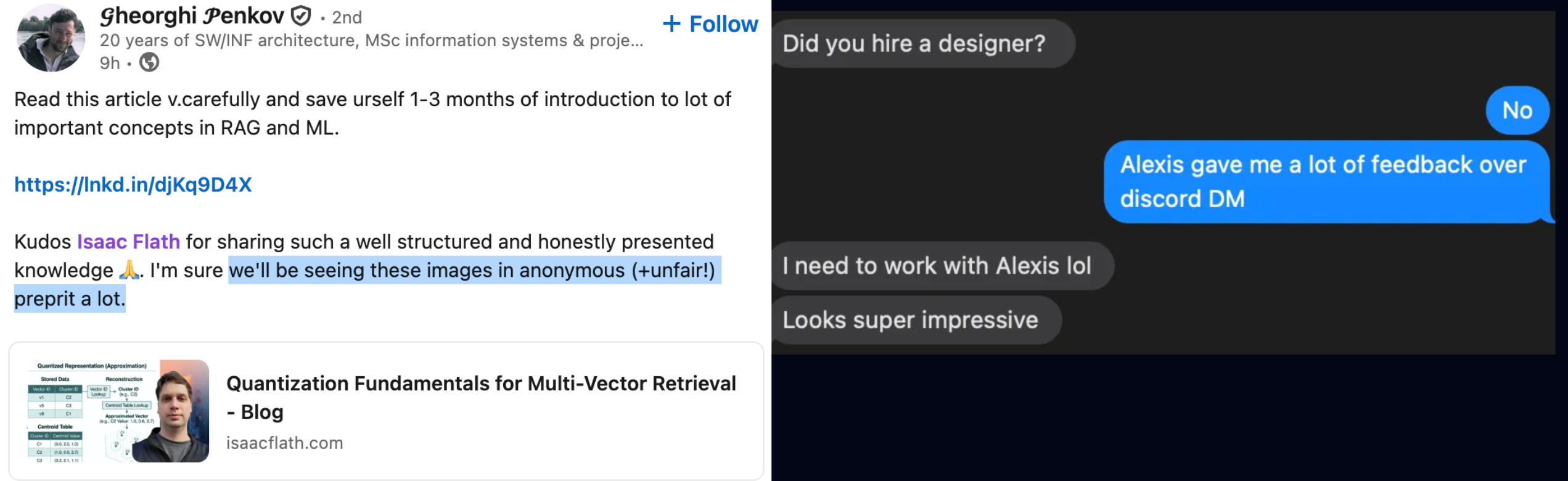
Here’s comments i’ve gotten in the last day on two completely different projects that were largely “AI generated”.
How were these made?
The secret to making things with AI that are high quality is…human expertise and human collaboration! Let’s talk through these 2 examples:
Example 1: A Well-Received Technical Blog Post
My blog post about quantization was very well received by the retrieval research community. One reader noted:
“Im sure we’ll be seeing these images in anonymous (+unfair!) preprint a lot.”
Raw2Draft generated those images in seconds with out-of-the-box features. So, how could they be valuable?
I added human expertise in two ways:
Deep Work and Peer Review: I studied the material and the codebases extensively, and thought a great deal about how to simplify. AI helped, but I drove the critical thinking. I also had knowledgeable friends review it and provide feedback (Thanks Alexis, Ben, and Dad!)
Domain Expertise in Prompting: I spent hours building the default prompt in Raw2Draft to make it “just work.” That time was spent developing the domain expertise to know what to put in the prompt. Here’s three of the many topics I had to learn about:
Data-ink ratio (tufte concept)
Gestalt principles
Visual rhythm
Then AI generated the images that I would not have made without AI. But expertise (subject matter + visual design principles) was what made it stand out quality wise.
Example 2: A Quality Landing Page
For another project, I built a landing page. When I showed a draft to my friend Hamel, he asked, “Did you hire a designer?”
No. AI coded the page.
My first attempt was okay. I had incorporated some basic ideas about color palettes and accents, but my UI knowledge is shallow. I wanted something that reflected the care I put into the project and show why I built it. So, I showed it to my friend Alexis
Alexis is an expert at many things, including UI/UX. On Discord DM, he sent a stream of brutally honest opinions. He called parts of the design cheap, generic, and “LinkedIn bland.” But he explained why it felt that way and linked to specific examples and resources.
It was very uplifting, and invaluable to me to build my own expertise.
The final result was the Raw2Draft landing page. And then I redid the Plot Builders and Kentro Tech landing pages with what I learned and they got drastically better as well.
Yet again, human expertise was the key, not AI.
Does this apply to everything?
No!
Not everything needs maximum time and effort. I don’t believe in sayings like “how you do anything is how you do everything”.
There are things you should pour your heart into. There are things you should ignore and avoid. And there are things that fall in the middle.
Here’s a couple examples.
Example 1
I respond to every DM from students and new professionals asking for advice. But my effort matches theirs.
“Hey, just starting out in DS, any advice?” > I give quick reply with some basic advice.
But a thoughtful message showing they’ve put time into it? I spend a lot of time on it. I’ll read and critique links they provided, look for their github, read recent socials stuff they’ve published, scan their blog, and respond as best I can.
I don’t have time available to give my all to every one, I wish I did. But I also don’t feel good completely ignoring messages from people who are reaching out for help, even if they aren’t going about it the right way. I’d rather use a sliding scale rather than a binary choice.
Example 2
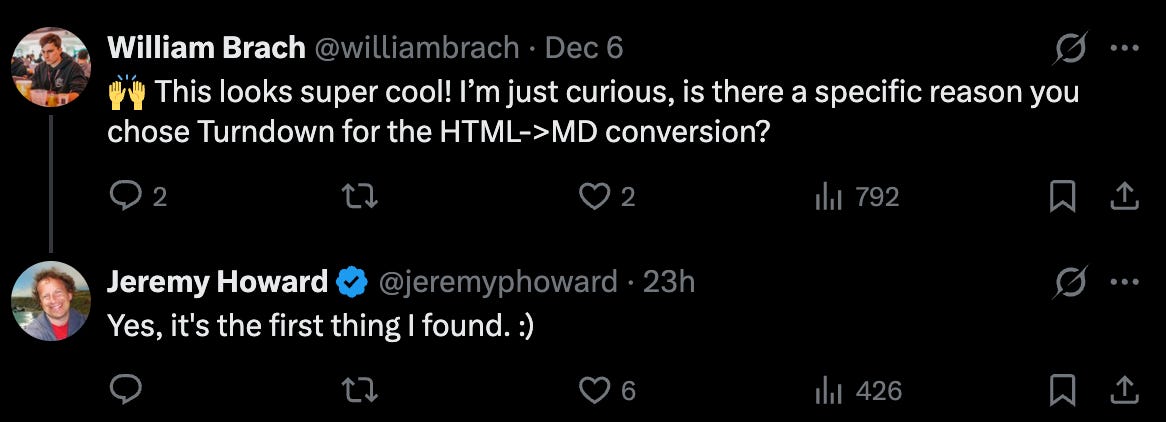
When building software, sometimes the best tool is often the first one that works. I could do an exhaustive search to find the best tool for what I need
But it’s not always worth the time.
Picking something fast/quickly, and putting real effort in if it’s ever needed is a great approach. Because often, that real effort is never needed.
This is well captured in this twitter exchange I saw today.
Of course, on other things (say, collecting payments or storing user data) that effort should be put in upfront to get things as close to right as possible. Double charging people can cause a lot of harm!
Nuance is needed.
How to Find Honest Feedback
Both of the examples showed me growing and learning quickly based on feedback from friends. Trusted friends who were willing to tell me something I made could be better, in a super honest and productive way. So, how do you get people to give you the honest feedback that helps you grow?
First, we need to clear up a misconception.
People often talk about the risks of surrounding yourself with “yes-men”. That’s not how it happens. People don’t find or stumble upon “yes-men”, they create them with how they respond to opinions.
It’s a skill to build a circle of people who will give you brutally honest feedback. And in my experience, few people (or companies) have done it. People quickly learn which topics to have an opinion about, and which topics they self-censor and hold back.
If you’ve gotten frustrated that people you know aren’t honest with you when it comes to feedback, it’s time for introspection!
Centriam and a previous client Specstory are two fantastic examples of doing this well. They truly show appreciation for employee opinions, especially dissenting ones.
It’s also hard to know when you’ve created this environment! Nobody feels like they created that environment. And it typically shows where there’s topics people feel safe sharing an opinion about and other topics where they don’t and self-censor. And if you ask directly, you may not get honest feedback because you’ve created the environment that prevents it!
This is *especially* true in companies where there’s a whole employer/employee and income dynamic that complicates things further. And it spirals! Because if a person feels that you don’t listen to their opinions, then they begin to resent yours as well!
The concept is obvious, but the practice is hard. I still fail more often than I would like. It stings when I realize I haven’t done it quite right, even if it’s in a very tiny way like not being quite as energetic in the moment as I would have liked.
Thank them sincerely. Especially when they are so honest it stings a bit
Show, don’t just tell. Follow up and demonstrate how their feedback improved the work.
Explain your process. If you don’t use their advice directly, explain what you learned and why you went a different direction. This shows respect for their input and proves you thought about it deeply.
Outwork them. Spend five times more effort learning from the feedback than it took them to give it. This is most important because it makes the rest actually matter. If you do this, you will grow enough that when you thank them you are genuine. When you show them how you improved they can see it. And when you explain what you did, you’re actually giving some valuable back.
Do this, and you’ll get more and more of the honest feedback that you want. It’s a skill worth developing.